
Target: Bridging the AI Gap
We conducted a comprehensive UX research study to address declining sales and high cart abandonment by integrating AI-driven comparison tools into Target's existing digital and in-store shopping journey.
Role
UX Reseacher
UI Designer
Presentation Designer
Team
2 Other UX Researchers
Timeline
2 months (prototype)
January 2026 - March 2026

%201.svg)

.svg)

Issues at target
background
Target has a problem
Target is facing declining sales while continuing to invest in stores, digital experiences, and AI driven shopping. Although digital sales are increasing, mobile cart abandonment remains a key issue impacting conversion. At the same time, Target’s ChatGPT integration has low awareness and limited adoption among users. Thus, This challenge is important because improving checkout and AI adoption directly impacts revenue, user trust, and long term retention.
who is it for?
Primary Stakeholders
- Digital & In-Store Shoppers:
- Early Tech Adopters
Business Stakeholders
- Target Corporation
- Store Administrators and Executives
- Target Technology & Product Teams
hypothesis
Theories about Target Shoppers
AI Adoption Gap

Users are not adopting Target’s ChatGPT integration because the entry point has low awareness and the current implementation is not naturally integrated into established shopping habits.
Checkout Friction & Revenue

Mobile cart abandonment is a primary issue impacting overall conversion rates, and improving the checkout flow will directly increase revenue and user retention.
In-Store Digital Reliance

Shoppers are increasingly dependent on their mobile devices while physically in-store to validate purchase decisions through price comparisons and reviews.
Research and Design Objectives

Pinpoint specific obstacles in the mobile checkout process that contribute to high cart abandonment rates.

Observe how shoppers use their phones in-store to identify unmet needs and opportunities for digital-physical connection.

Understand why Target’s current AI-assisted shopping features have low adoption and how they can be better aligned with natural user flows.

Compare Target’s app performance and feature set against competitors like Walmart to identify gaps in price visibility and decision-making speed.
Research
Methodologies
Understanding Target's digital journey.
Target is a major U.S. retailer currently grappling with declining sales, high mobile cart abandonment, and low AI adoption. As the company executes a $5 billion modernization strategy, this research aims to pinpoint specific digital friction points that impede the shopping journey
Desk Research: We conducted desk research by synthesizing insights from over eight secondary sources, ranging from Statista reports to unfiltered user sentiment on Reddit and YouTube. This phase established a foundational understanding of industry trends, checkout friction, and consumer skepticism toward AI.
Competitive Teardown: We conducted a structured analysis of five critical user journeys comparing Target to its closest competitor, Walmart. This allowed us to benchmark Target’s brand-focused experience against Walmart’s strengths in speed and price transparency.
Usability Interviews: We performed remote interviews using a structured note-taking grid to capture specific task completion behaviors. We chose this method to pinpoint exact friction points within the checkout flow and to evaluate the current discoverability of AI tools.
Ethnography: We spent 1.5 hours observing shoppers in-store to record real-time interactions and mobile device usage. This method helped us identify "unmet in-store needs" and understand how users physically bridge the gap between the app and the shelf.


desk research
Shoppers in the Wild (online)
To build a robust foundation for our research, we synthesized data from over eight secondary sources, ranging from quantitative market reports to qualitative user discussions. We selected these specific channels to bridge the gap between high-level industry trends and the unfiltered, "in-the-wild" experiences of real Target guests
Results summary:
1
Shoppers are frequently frustrated by inventory inaccuracies, where items marked "in stock" disappear by the time they reach the shelf, leading to order cancellations and lost trust.
2
Mobile cart abandonment isn't just about second thoughts; it’s driven by technical friction. Forced account creation, long forms, and app glitches at the final payment step create a "leaky bucket" where ready-to-buy users simply give up.
3
While Target has invested in a ChatGPT integration, we found that awareness is nearly non-existent among mainstream shoppers. Users currently view AI as a research tool for validation—asking questions like "Is this a good price?"—rather than a transactional tool integrated into their natural flow.

competitive audit
Benchmarking Target’s Brand Experience Against Walmart’s Efficiency.
Our competitive teardown involved a structured analysis of five critical user journeys (CUJs), comparing Target’s polished, brand-focused experience against Walmart’s efficiency-driven model. Using a 1–5 scoring system, we evaluated how each app handled the end-to-end shopping process
While both retailers are direct competitors in price and convenience, their digital strategies offer a sharp contrast in user priorities. Walmart’s app provides stronger price visibility and faster decision-making, whereas Target delivers a more polished but slightly slower experience that prioritizes design and curation.
The Discovery Gap
Target struggled significantly in Category Browsing (2/5) and AI Product Discovery (2/5). While Target excels at "Search" (finding a known item), it fails to help users explore or use AI tools to narrow down choices compared to Walmart’s highly efficient discovery features.
Price Transparency
Walmart’s emphasis on speed and price signals makes it easier for value-conscious shoppers to validate their decisions quickly. Target’s experience is often hindered by a lack of side-by-side comparison tools, forcing users to "mental-track" differences across multiple screens.
The AI Advantage
Walmart currently leads in AI integration (4.5/5), offering a more intuitive way for users to discover products through conversational tools, while Target’s integration remains low-awareness and niche.
.png)
The verdict
Walmart has optimized for the transactional shopper who values time and clarity, while Target has optimized for the browsing shopper. To close this gap and reduce cart abandonment, Target must integrate more functional "value signals" and better comparison tools into its polished design.
usability study
Pinpointing friction in comparison, checkout, and AI discovery in the Target app.
Our usability interviews involved 30-minute remote sessions with six participants, where we used a structured note-taking grid to track task completion, behavioral patterns, and emotional responses. By analyzing these cross-participant interactions, we moved beyond what users said to identify exactly where the digital experience was failing them.
This phase of research focused on the high-friction moments of mobile cart abandonment and AI adoption. By observing participants as they navigated the app, we discovered that users don’t just shop—they interrogate the interface for value. When the app failed to provide clear signals like unit pricing or side-by-side comparisons, participants immediately lost confidence, leading to the "decision fatigue" that drives abandonment.
Snapshot of Interviews with Rainbow Sheet

usability study
Key findings
usability study
Key Themes
The Comparison Barrier
Participants expressed frustration over the "back and forth" required to evaluate similar products. The grid showed a recurring pattern where users would add multiple items to their cart just to compare them, effectively turning the cart into a "decision graveyard" where items were abandoned once a choice was finally made.
AI as an "Invisible Search"
The note-taking grid highlighted a significant AI experience gap. Users did not naturally discover the ChatGPT integration; when prompted to use it, they viewed it as a basic research tool rather than a trusted shopping assistant. Some even struggled to find it.
usability study
Quotes
“It’s hard to know which one is actually cheaper without price per unit.”
“I'm guessing if the AI suggests me something like... this is the top pick."
“I wish I could compare two products side by side instead of going back and forth.”
ethnography study
Uncovering in-store friction to enhance omnichannel trust.
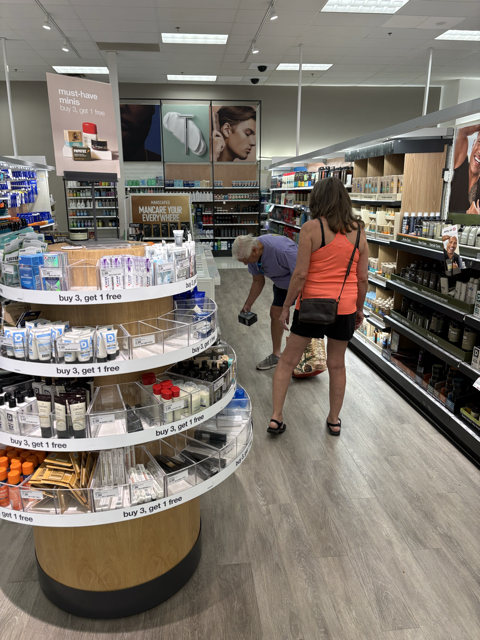
To understand the real-world friction between Target’s digital tools and the physical shopping experience, we conducted 1.5 hours of in-store ethnography. We observed shoppers in their natural environment to record repeated behaviors and identify unmet in-store needs. This research was critical for uncovering how the mobile app serves as a "shopping sidekick" and where it fails to support users during the physical journey.
Ethnography Takeaways
Validation Habit
We observed a significant pattern of shoppers using their phones in-store for price comparison, reading reviews, and confirming purchase decisions. This behavior confirms that the mobile app is a critical touchpoint for validation, not just a secondary tool.
The Physical Comparison Struggle
Shoppers often inconvenience themselves by bending, lifting items, or squinting at labels to manually compare products. The current app experience does not fully support quick, clear comparisons within the physical aisle.
Wayfinding and Inventory Gaps
A major unmet need identified was precise in-store wayfinding. Shoppers need more than just "in-stock" indicators; they require clear aisle/shelf locations and real-time inventory reliability to avoid the frustration of missing items.
Fragmented Trip Planning
We found that users desire a tighter integration between their digital shopping lists and real-time store inventory. Without this, the transition from home planning to in-store execution feels disconnected and adds a significant mental load to the trip.
Experience design
Execution
Solving for physical inconvenience and fragmented journeys.
The research revealed that Target’s digital experience often breaks at comparison and confidence. While 78% of users rely on price and value signals to make a choice, the current app makes it difficult to compare options side-by-side, leading to decision fatigue and cart abandonment. To solve this, I redesigned the comparison journey into two frictionless flows that integrate AI directly into the user's natural shopping habits.
1
Compare Button to Floating Action Button
2
Compare with AI
3
Compare with AI (Scan Mode)
.png)
Ai assisted product comparison
2
Compare with AI
Once items are selected, users can bypass the traditional static list and select "Compare with AI". This sends the product data directly to an integrated ChatGPT experience. ChatGPT is informed solely by the product comparison list that already exists in the Target App.
The user does not see that screenshots of this comparison list are sent to ChatGPT in the backend, and a prompt custom to their shopping habits is placed into the chat in order for the best product to be recommended to them in a personalized manner.
AI assisted in-aisle scanning
3
Compare with AI (Scan Mode)
A user can scan one item on the shelf and then "Scan another item" to immediately trigger the comparison tray. They can then use the Compare with AI button to get an instant verdict while standing in the aisle
This removes the need for manual labor in the aisle. The user no longer has to lift multiple bulky packages to read labels or squint to traverse the aisle looking for specific markers; instead, the app aggregates and provides a clear, voice- or text-based comparison.
Design impact
Increased Discoverability
AI is surfaced within existing flows rather than requiring a separate search.
Reduced Friction
Users avoid manual prompting and sending screenshots to the ChatGPT app, speeding up the path to purchase.
Strengthened Trust
By providing clear "Bottom Line" verdicts, the app builds the shopper confidence necessary to reduce cart abandonment.